



Last updated: September 2026
by Jess Knauf, Co-Founder, Family Law Service. Reviewed by Belinda Atkins, Managing Director, Family Legal Ltd. Information is current as of 22 September 2026.
Quick Summary
- Getting divorced does not end financial claims. Only a court order that dismisses them does.
- If no financial order was ever made, a pension claim after divorce can be made years, even decades, later.
- There is no fixed time limit in England and Wales, but delay can reduce what a court is willing to award.
- Remarrying stops you claiming most types of order for yourself, unless you applied before you remarried.
- A clean break consent order is the usual way to close the door on future claims for good.
Pension claim after divorce
A pension claim after divorce is possible in England and Wales if your financial claims were never dismissed by a court order, because the final order ends the marriage but not the right to ask for a share of your ex’s pension. There is no set deadline, although the court will look closely at delay and at how much of the pension was built up after you separated. A clean break consent order is what brings those claims to an end.
A pension claim after divorce is something many people never think about until a letter arrives, or until they start planning their own retirement and wonder whether they missed out. It often comes as a surprise that the final order, the document that legally ends a marriage, says nothing about money. If the finances were never formally settled by the court, the door can stay open for years.
That can be worrying whichever side of it you are on. You might be the person who gave up work to raise children and now has little pension of your own. Or you might be the one who kept paying in, and is now anxious that an ex could come back for a share. This guide explains when a late claim is possible, what a court would look at, and the practical steps to take. At Family Law Service, we help people deal with exactly this, on a fixed fee, without the cost of a traditional solicitor.
Why a Pension Claim After Divorce Is Still Possible
Divorce and money are two separate legal processes. The divorce itself ends the marriage. Financial claims after divorce, including claims for a share of pensions, property, savings and maintenance, stay alive until a court makes an order that deals with them. This is set out in the Matrimonial Causes Act 1973, which gives the court its powers over money on divorce.
An informal agreement is not enough. Many couples split things between themselves, shake hands and move on. That agreement may have felt final, but without a sealed court order it does not stop either person applying later. It is one of the most common mistakes people make with financial settlements, and it is the reason late pension claims happen at all.
The case that made headlines: Wyatt v Vince
The best-known example is Wyatt v Vince [2015] UKSC 14. The couple divorced in 1992 and no financial order was made. Nearly 20 years later, the wife applied for financial provision after her former husband had become very wealthy. The Supreme Court allowed her claim to go ahead, confirming that there is no time limit on these applications. The court was also clear, though, that the long delay and the circumstances of the case would weigh heavily on how much she might receive.
That is the balance to keep in mind. A claim being possible does not mean it will be generous.
When Can You Make a Pension Claim After Divorce?
Whether a pension claim after divorce is open to you depends mainly on what happened to your finances at the time, and on what has happened in your life since. This table gives a quick overview for England and Wales.
| Your situation | Can a pension claim still be made? |
|---|---|
| Divorced, no financial order ever made, neither of you has remarried | Yes, usually. Claims remain open, with no fixed time limit. |
| A clean break consent order was made | No, in almost all cases. Claims were dismissed when the order was made. |
| A financial order was made, but it left maintenance open | Limited. Some claims may be varied, but not reopened from scratch. |
| You have remarried or formed a civil partnership | Much harder. Most claims for yourself are barred unless you applied before remarrying. |
| Your ex has died | Not under divorce law. A separate claim against the estate may be possible in some cases. |
The remarriage trap
Under section 28(3) of the Matrimonial Causes Act 1973, if you remarry or form a civil partnership, you can no longer apply for a lump sum, maintenance or a property order for yourself against your former spouse. The exception is where your claim was already made before you remarried, for example if you started a financial application first.
Whether that bar also stops a standalone pension sharing claim is a more technical point, because section 28(3) does not mention pension sharing orders by name. It is not something to rely on either way without advice. If you are planning to remarry and your finances were never finalised, it makes sense to deal with them first.
Divorces started before December 2000
Pension sharing orders, which split a pension into two separate pots, are only available where the divorce proceedings started on or after 1 December 2000. For older divorces, a court may instead use pension attachment (where part of the pension is paid to the ex when it comes into payment) or offsetting (where the other person receives more of the other assets instead). Our guide to pension sharing orders explains how each option works in practice.
“We regularly hear from people who divorced ten or fifteen years ago and assumed everything was finished because they had the final order. It is a real shock to learn their ex could still ask for a share of a pension. The good news is that it is usually very fixable. A clean break consent order can often be put in place years after the divorce, and once the court approves it, both people can plan their futures properly.
Jess Knauf, Co-Founder, Family Law Service
What Would a Court Look At Years Later?
If a late pension claim reaches court, the judge applies the same factors as in any financial case, found in section 25 of the Matrimonial Causes Act 1973. The difference is that the picture now is very different from the picture when you separated. The court will usually consider:
- Delay: why the claim is being made now, and whether the other person has reasonably organised their life around it being over
- When the pension was built up: contributions made during the marriage are treated very differently from years of saving after you split
- Needs: each person’s income, housing and retirement needs today, including any new family
- Contributions: including raising children or supporting the other person’s career during the marriage
- The length of the marriage: a short marriage usually leads to a smaller share
In simple terms, someone who stayed at home through a long marriage and has no pension of their own may still have a meaningful claim. Someone who was married for a few years, then waited 20 years while their ex built up a pension from scratch, is likely to receive far less, if anything.
Example: a divorce that was never quite finished
This example is based on the kind of enquiry we often see. Sarah divorced in 2012 after a 16-year marriage. She kept the family home and her ex, Mark, kept his workplace pension. They agreed this between themselves and never went to court. Twelve years later, Mark’s pension had grown significantly and Sarah, now in her late 50s, had very little retirement income. Because no financial order had been made and neither had remarried, Sarah could still apply. With advice, they agreed a pension sharing arrangement that reflected the pension built up during the marriage, and then sealed it with a consent order so that neither of them could come back later.
Not Sure Where You Stand on a Pension?
Book a one-hour fixed-fee legal advice session on finances. We will look at what happened when you divorced and explain whether a claim is still open, in plain English.
How to Protect Yourself From a Pension Claim After Divorce
If you are the one worried about a future claim, the answer is to get your finances formally finalised. A clean break order is part of a consent order and dismisses both people’s claims against each other, including claims against pensions. Once it is approved by the court, neither of you can come back for more, even if one of you later becomes much better off. You can read more about when clean break orders are right for your situation.
A clean break does not have to mean nobody gets any pension. You can agree a pension sharing order and a clean break together, so the pension is divided now and all other claims end at the same time. Where the only thing needed is to close off claims, our online clean break consent order costs a fixed £499. Where pensions are being divided, or the finances are more involved, a premium consent order is usually the better fit.
The court fee for a financial order by consent is £62, as of July 2026 (Ministry of Justice fee update). That is far less than the cost of defending a contested claim years down the line.
Making a Pension Claim After Divorce: Step by Step
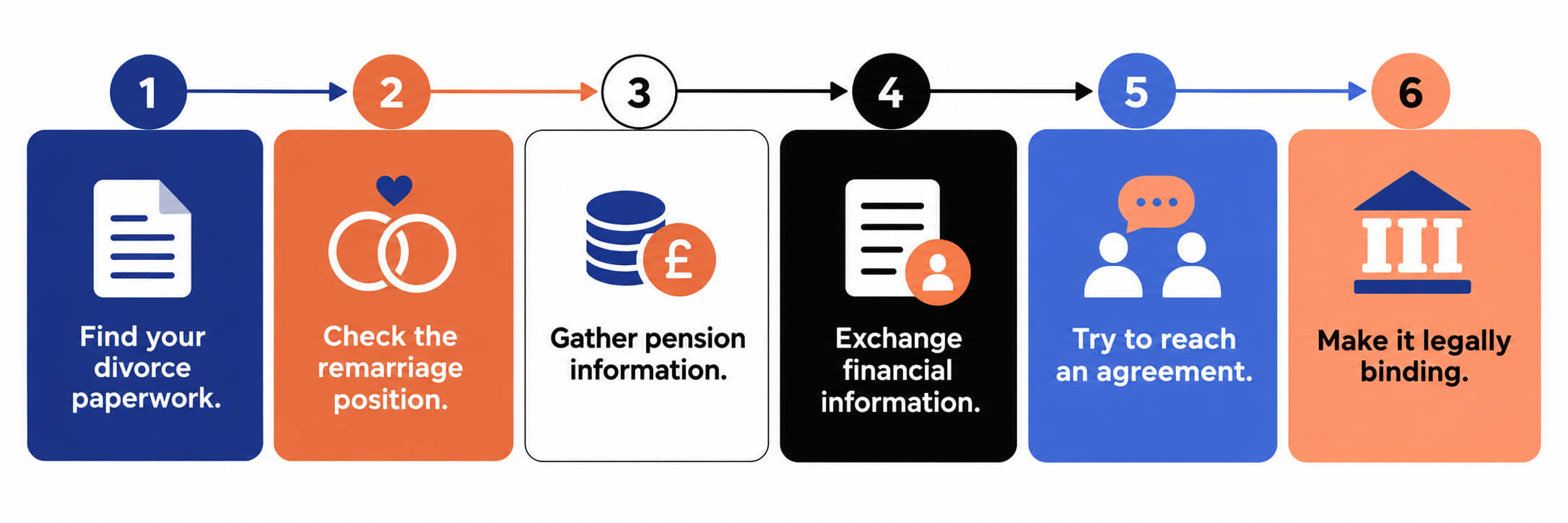
If you think you may be entitled to a share of your ex’s pension, these are the practical steps to follow.
- Step 1: Find your divorce paperwork. Check whether any financial order or consent order was made. If you are unsure, the court that handled your divorce can confirm this.
- Step 2: Check the remarriage position. If you have remarried or formed a civil partnership, get advice before doing anything else.
- Step 3: Gather pension information. Each pension provider can give a Cash Equivalent Transfer Value (CETV), which is the figure courts usually start from. Where pensions are large or complex, a Pensions on Divorce Expert (PODE) report can help.
- Step 4: Exchange financial information. Both people need to give full and frank disclosure. Our Form E completion service can take the stress out of this part.
- Step 5: Try to reach an agreement. Many late claims settle through negotiation or mediation, which is usually quicker and less expensive than going to court.
- Step 6: Make it legally binding. If you agree, it goes into a consent order. If you cannot agree, you apply to court using Form A, which has a court fee of £321 as of July 2026. You will normally need to attend a MIAM first, unless an exemption applies.
Mediate UK
Would You Rather Sort the Pension Without Going to Court?
If you would like to try mediation before taking legal steps, our sister company Mediate UK can help you both talk through the pension and reach an agreement. A MIAM is also the first step before most Form A applications, and legal aid for mediation is available if you meet the financial criteria.
What if a financial order was already made?
If a court order already dealt with your finances, you generally cannot start again just because a pension has grown. There are narrow exceptions, such as where one person hid assets or gave misleading information, or where something happened soon after the order that completely undermined the basis it was made on. Some ongoing orders, like maintenance or pension attachment, can also be varied. If you think one of these applies, a full case review is a sensible first step.
Summary
A pension claim after divorce is possible in England and Wales whenever financial claims were never dismissed by a court order. There is no strict time limit, but delay, the length of the marriage and how much of the pension was built up after separation all affect what a court would award. Remarrying stops most claims for yourself unless they were made first.
Whether you want to make a claim or protect yourself from one, the answer is the same: get the finances finalised in a court-approved consent order. It gives both of you certainty and lets you plan your retirement with confidence.
Frequently Asked Questions
Is there a time limit on a pension claim after divorce?
No. In England and Wales there is no fixed time limit on a pension claim after divorce if financial claims were never dismissed by a court order. However, the longer you wait, the more likely a court is to reduce or refuse the claim.
Can my ex claim my pension 10 years after divorce?
Yes, if no financial order was made and your ex has not remarried, they can still apply. A court would focus mainly on the pension built up during the marriage and on both of your needs now.
Does a final order stop financial claims after divorce?
No. The final order ends the marriage but does not deal with money. Only a financial order, usually a consent order with a clean break, dismisses financial claims after divorce.
Can I get a clean break order years after my divorce?
Yes. As long as you are both in agreement, a clean break consent order can be applied for after the final order, even many years later. The court fee is £62 as of July 2026.
Can the State Pension be shared on divorce?
The new State Pension cannot generally be shared on divorce. Some older additional State Pension entitlements can be, so it is worth checking your State Pension forecast before agreeing a settlement.
Does this apply in Scotland?
No. This guide covers England and Wales. Scotland has different rules on dividing pensions and on time limits for financial claims, so you would need Scottish legal advice.
You Might Also Find Helpful
Clean Break Consent Order Guide Read the guide |
How to Protect Savings During a Divorce Find out more |
How Is a House Split During Divorce? Learn more |
When Mediation Is Not Suitable View the guide |
Ready to Take the Next Step?
Whether you want to claim a fair share of a pension or close the door on future claims, we can help on a fixed fee. Our consent order services are usually quicker, less stressful and far less expensive than paying traditional solicitor fees.