


Last updated: August 2026
by Jess Knauf, Co-Founder, Family Law Service. Reviewed by Belinda Atkins, Managing Director, Family Legal Ltd. Information is current as of 23 August 2026.
Quick Summary
- Family courts in England & Wales regularly refuse consent orders believed to have been written by AI tools, and require the couples to submit again using the correct court format.
- The problem is not that AI writes badly. It is that the court expects a specific document, Form 2.1 of the Standard Family Orders, and AI produces bespoke prose that only looks like one.
- Where a term sits inside the order decides whether a judge can enforce it later. AI does not reliably get that right, and you would have no way of knowing.
- We build AI legal tools ourselves, so this is not a case of being anti-AI. AI is useful for understanding your options and pressure-testing whether your settlement is fair. It is not yet reliable enough for the drafting consent orders.
- Our fixed-fee online clean break consent order is £499, drafted by a family law specialist and submitted in the format the court expects.
CAN AI WRITE A CONSENT ORDER
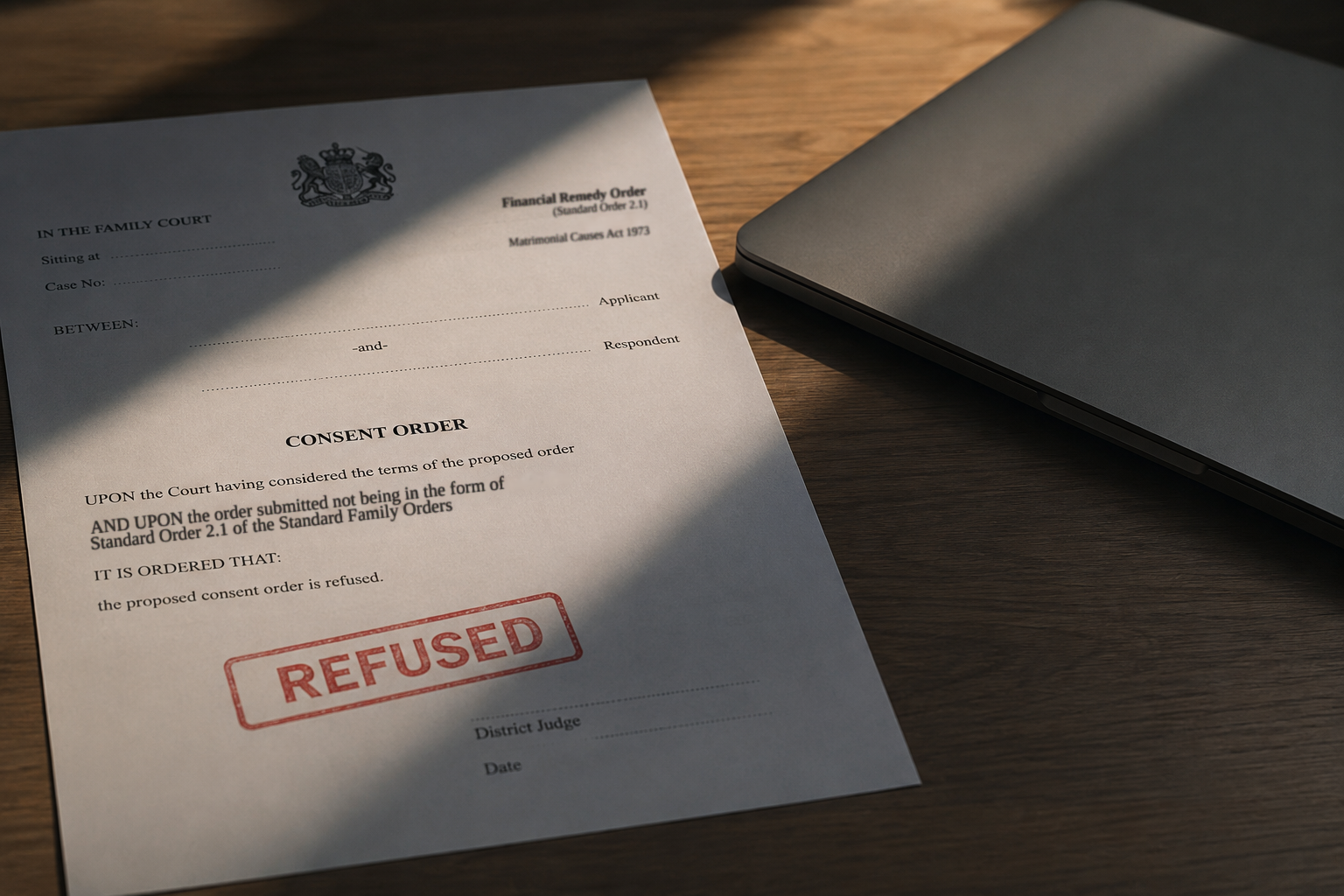
AI can produce something that looks like a consent order, but it cannot reliably produce one a family court in England and Wales will approve. The court expects the agreement to be set out in Form 2.1 of the Standard Family Orders, with the paragraphs that do not apply deleted. AI tools write bespoke documents instead, and judges have already refused orders for exactly that reason.
If you have been wondering can AI write a consent order, you are asking a sensible question. You have reached an agreement with your ex, you both know what you want, and paying someone to type it up feels like an avoidable cost. ChatGPT will happily produce a document in thirty seconds that reads like a court order, complete with recitals, numbered paragraphs and a clean break clause.
Then you send it to the court, and months later it comes back refused. We know this happens, because couples come to us at Family Law Service to put it right, usually after the second refusal rather than the first. In one recent case we have seen, the judge said so in writing.
If the legal side of a divorce is still fairly new to you, it is worth getting a feel for how the pieces fit together before deciding who drafts what.
Can AI Write a Consent Order? The Court’s Answer, in Writing
Many articles on this subject argue from theory. This one does not need to. Below is the reasoning a family court in England gave when it refused a submitted order in 2026. We have removed the names, the case number, the court and every other identifying detail. The wording of the reasoning itself is unchanged.
Extract from a court order | England and Wales, 2026 | Names, case number and court redacted
“The parties have not produced a consent order which follows the formula for a clean break (or such other order as they ask the court to make) in Form 2.1 of the Standard Family Orders (with irrelevant paragraphs deleted). A link was set out in the previous order. The parties must produce an order in that form, rather than the bespoke order they have submitted. The submitted order bears the hallmarks of having been produced by a large language model / Artificial Intelligence, but whether or not that is true, it does not follow the standard family order format. The court will offer the parties a final opportunity to produce an order giving effect to their agreement, which the court will then reconsider without a hearing.”
Read that last sentence again. A final opportunity. This couple had already agreed everything between themselves. Nothing was in dispute. They still lost months, and they were one more attempt away from being sent back to the start of the financial process.
Notice too what the judge did not say. There is no complaint about the quality of the writing, no suggestion that the couple had agreed something unfair, and no accusation of dishonesty. The order failed on format. It was a well-written document that was not the document the court had asked for.
Why AI Cannot Write a Consent Order the Court Will Accept
1. The court wants a standard form, not an original document
This is the single point that almost every article on AI consent orders misses, and it is the reason the order above was refused. Financial orders in England and Wales are not written from scratch. The judiciary publishes a set of Standard Family Orders, and Form 2.1 is the financial remedy order that contains the clean break wording. A drafter starts with that form and deletes the paragraphs that do not apply to the couple.
Free download
See Form 2.1 for yourself
This is the standard financial remedy order the court asked that couple to use. Open it alongside anything an AI tool has produced for you and the difference is immediate. Word document, published by the judiciary.
Have a look at it. It runs to dozens of numbered paragraphs covering lump sums, property, pensions, maintenance, undertakings and costs, each with wording the court already recognises. That is the shape of the document a judge expects to open.
A large language model does the opposite. It generates fresh text that resembles the many orders it has seen. The output can be perfectly coherent and still be the wrong instrument, in the same way that a beautifully typed letter is not a passport. Judges read hundreds of these documents and recognise the standard form instantly, which is why an original one stands out.
2. Where a term sits decides whether it can be enforced
A consent order has distinct sections that do different legal jobs. There are recitals, which record what the parties have agreed or intend. There are undertakings, which are promises given to the court. And there is the body of the order, which contains the terms a judge can actually enforce if someone stops complying.
Put the wrong term in the wrong section and you may believe something is binding when it is not. This is the failure that costs people real money years later, and it is invisible on the page. Everything looks fine. It reads like an order. You would only discover the problem at the moment you needed to rely on it, which is usually the worst possible moment. We cover more of these traps in our guide to common mistakes in financial divorce settlements.
3. AI is built to agree with you
Chat tools are trained to be helpful and cooperative, which sounds harmless until you are asking one whether your settlement is fair. Push back on an answer and it will often change its position rather than defend it. If you have framed your question in a way that assumes a particular outcome, the AI will usually build the document around that assumption without ever telling you the assumption was the problem.
A judge applies section 25 of the Matrimonial Causes Act 1973, which sets out the factors the court weighs when deciding whether a financial settlement is fair. That includes the needs of any children, earning capacity, the length of the marriage and each person’s future position. An AI tool has no duty to test your agreement against those factors, and no consequence if it gets it wrong. Our guide to how financial settlements are decided sets out what a judge actually weighs up.
4. It cannot check a single figure you give it
Consent orders live or die on accuracy. Property titles, mortgage balances, pension scheme names, transfer values, account numbers. If you type a wrong pension provider or an out of date valuation, the AI will build a flawless document around a false fact. Pension terms are especially unforgiving, and a pension sharing order that names the wrong scheme or omits the annex is worthless. Our guide to pension sharing orders explains what has to be right.
5. You are handing over a lot of personal data
To draft an order properly, an AI tool needs your full names, addresses, property details, bank and pension account numbers and your children’s details. On a free consumer chat tool, that conversation may be retained and used for training. The judiciary’s own guidance on AI for judges, refreshed in October 2025, tells judicial office holders to treat anything typed into a public AI tool as though it had been published to the world. That is a reasonable rule for you to borrow.
“We are not AI sceptics. We build and run AI tools of our own, and we use AI every day. What we see in practice is a very specific gap. AI is good at helping someone understand what they are entitled to and whether their agreement sounds reasonable. It is not good at producing the actual court instrument, because that is a formatting and enforceability job, not a writing job. The couples who come to us with a refused order have almost always got the agreement right and the document wrong.”
Jess Knauf, Co-Founder, Family Law Service
Already Agreed Everything? Let Us Draft It Properly.
Our online clean break consent order is a fixed £499, drafted by a family law specialist in the standard court format and checked before it goes anywhere near a judge. No hourly billing, no surprises.
Where AI Genuinely Does Help With a Divorce Settlement
We would rather give you an honest map than a scare story. There are parts of this process where AI is a real asset, and telling you otherwise would not be true.
- Understanding the language: asking what a clean break, a Mesher order or a pension attachment actually means, in plain English, before you agree to one.
- Pressure-testing your thinking: asking an AI to argue against your proposal and find the weaknesses in it. Ask it to challenge you rather than help you, and the answers get much more useful.
- Explaining the box 13 question: the Form D81 statement of information asks you to explain why your settlement is fair. AI can help you organise that reasoning, as long as the underlying facts are yours and correct.
- Preparing for a conversation: working out your questions before a mediation session or a legal advice appointment, so you use the time well.
- Getting a first read on where you stand: our own AI Barrister Review gives you a written assessment of your financial position, built on a structured legal reference index rather than a general chat model.
The line sits at the document itself. Use AI to work out what you want. Do not use it to produce the thing you file at court. And if a question keeps nagging at you after all that reading, an hour of fixed-fee legal advice on finances will usually settle it faster than another evening of prompting.
What It Costs When an AI Consent Order Is Refused
The saving from drafting it yourself is real, right up until it is not. Here is what the two routes look like side by side.
| AI-drafted order | Fixed-fee drafted order | |
|---|---|---|
| Drafting cost | Nothing | £499 fixed |
| Court fee | £62, the same either way | £62, the same either way |
| Format | Bespoke prose, not the standard form | Form 2.1, irrelevant paragraphs removed |
| If it is refused | Redraft, resubmit, wait again, often several months | We handle amendments and resubmission |
| If a clause is unenforceable | You may not find out for years | Checked before submission |
The court fee for a financial order by consent is £62 as of July 2026, following the fee rise on 13 July 2026 (see the Ministry of Justice announcement). You pay it once. If the court sends your order back and you correct it, you are still within the same application, so there is no second fee to find. What a refusal actually costs you is time, and time is not neutral here. Until a sealed order is in place, neither of you has a clean break, and either of you could in principle make a financial claim against the other. Circumstances move on in the meantime: a house is sold, a pension is transferred, someone remarries, and the agreement you carefully reached no longer fits the facts.
What We See When a Rejected Order Lands on Our Desk
Anonymised example: a straightforward agreement, refused twice
A couple in their fifties had agreed everything: the house sold, proceeds split, pensions left alone, and a clean break on both capital and income. They generated the order themselves and filed it. It came back with a request for amendments. They fed the court’s comments back into the same tool, resubmitted, and it was refused again. By the time they came to us they had lost the better part of a year and the housing market had moved. The agreement was never the problem. The document was. We redrafted it on the standard form and it was sealed without further comment.
The pattern is remarkably consistent. Sensible people, a fair agreement, a document that cannot do the job. The second refusal is the one that hurts, because by then the couple have usually stopped speaking to each other about it and the goodwill that produced the agreement has drained away.
If you have not yet reached an agreement, or the discussion has stalled, financial mediation is usually quicker and less expensive than fighting it out through solicitors or the court. Family Law Service does not provide mediation, but our sister company does.
Mediate UK
Not Agreed the Finances Yet?
Our sister company Mediate UK helps couples reach a financial agreement without going to court, which is usually faster and considerably cheaper than each instructing a solicitor. If you are not sure where to start, a free 15-minute call will tell you what your options look like.
The Courts Are Already Alert to AI-Generated Documents
The order quoted above is not an isolated moment of judicial suspicion. In R (Ayinde) v London Borough of Haringey [2025] EWHC 1383 (Admin), the Divisional Court dealt with legal submissions containing case citations that did not exist, and Dame Victoria Sharp warned plainly that AI platforms are not capable of conducting reliable legal research. Wasted costs followed.
That case involved lawyers. The point for anyone representing themselves is simpler and sharper. Judges now know what AI output looks like, they are reading for it, and when they spot it they scrutinise the document more closely rather than less. Submitting a generated order is not a neutral act.
So Can AI Write a Consent Order? What to Do Instead
Step 1: Get the agreement right first. Use whatever helps, including AI, to understand your options and sense-check fairness. This is the part where your own judgment matters most.
Step 2: Exchange honest financial information. Both of you need a clear picture of property, savings, pensions, debts and income before anything is signed. A court can set aside an order later if disclosure was not full and frank, so this is not a corner to cut. If you would rather not tackle the paperwork alone, we also handle Form E completion.
Step 3: Have the order drafted on the standard form. For a straightforward split with a clean break, our clean break consent order guide walks through what is involved, and the drafting itself is £499. Where there are pensions to share, a business, or an overseas asset, the premium consent order service is the better fit.
Step 4: File it with Form A and the Form D81. The order goes to the court with a Form A by consent and a statement of information. Help is available if you would like someone to complete the Form A for you.
Summary
AI can write something that reads like a consent order. It cannot reliably produce the document a family court in England and Wales will seal, because the court expects Form 2.1 of the Standard Family Orders with the irrelevant paragraphs removed, and a language model generates original prose instead. A judge has already refused an order on precisely that basis and given the couple a final chance to get it right.
Use AI for the thinking. Use a specialist for the document. A clean break order settles your finances permanently, so the cost of getting the format wrong is measured in years rather than pounds. At £499 fixed, having it drafted properly is the cheaper option in almost every version of events where something goes wrong.
Frequently Asked Questions
Will a court reject a consent order because it was written by AI?
There is no rule banning AI-drafted orders. In practice they are refused because they do not follow the standard court format. One court in 2026 noted that the order before it bore the hallmarks of a large language model, then made clear that the real objection was the format rather than the tool used to produce it.
What is Form 2.1 of the Standard Family Orders?
It is the financial remedy order in the judiciary’s published set of standard family orders. It contains the standard wording for capital orders, property, pensions, maintenance and the clean break provisions. A drafter starts from this form and deletes the paragraphs that do not apply, rather than writing an order from scratch.
Can I use ChatGPT to check a consent order someone else has drafted?
You can ask it to explain what the clauses mean, which is a reasonable way to make sure you understand what you are signing. Be careful about relying on it to spot errors, since it will not know whether a clause has been placed in the recitals rather than the body of the order, and that placement is what decides enforceability.
How much does it cost to have a consent order drafted properly?
Our online clean break consent order is £499 as a fixed fee, with a premium service for more complex cases involving pensions or business assets. The court fee for a financial order by consent is a separate £62, as of July 2026. Solicitors typically charge by the hour, so the total can be considerably higher and harder to predict.
What happens if my consent order is refused?
The court will usually explain what is wrong and give you a chance to submit a corrected version. That opportunity is not unlimited. In the case quoted in this article the couple were told it was their final opportunity, and a refused order means your finances stay legally open in the meantime.
Is it safe to put my financial details into an AI chat tool?
Treat anything you type into a public AI tool as though it could become public. That is the standard the judiciary applies to its own judges. If you want to use AI to think through your options, it is safer to describe your situation in general terms than to paste in account numbers, addresses and full names.
You Might Also Find Helpful
Ready to Take the Next Step?
If you have already agreed how to divide your finances, we will draft your clean break consent order on the standard court form for a fixed £499. More than 23,000 people have used our services, and we hold 715+ 5-star reviews.