



Last updated: August 2026
by Jess Knauf, Co-Founder, Family Law Service. Reviewed by Belinda Atkins, Managing Director, Family Legal Ltd. Information is current as of 18 August 2026.
Quick Summary
- In mediation you and your ex-partner make the decisions. In arbitration, a qualified arbitrator makes the decision for you.
- Mediation is almost always cheaper and is the usual first step, because most people need to attend a MIAM before applying to court anyway.
- Arbitration suits couples who have genuinely tried to agree, cannot close the gap, and want a binding answer without waiting for a court listing.
- Both count as non-court dispute resolution, and since April 2024 the family court can penalise you on costs for refusing to try either without a good reason.
- Whichever route you take, a financial agreement only becomes legally binding once it is approved by the court as a consent order.
Arbitration vs Mediation
The difference between arbitration vs mediation comes down to one thing: who makes the final decision. In mediation, an impartial mediator helps you and your ex-partner reach your own agreement, and nothing can be imposed on you. In arbitration, you appoint a qualified family arbitrator who hears both sides and issues a binding decision called an award.
Choosing between arbitration vs mediation is one of the first real decisions separating couples face, and it shapes everything that follows. Both options keep you out of a contested final hearing. Both are usually quicker and cheaper than fighting a case through the family court. They work in very different ways though, and picking the wrong one can cost you months you did not need to lose. If you are still getting your bearings, our guide to how it all works sets out where each option sits.
The frustrating part is that most people are told to “try mediation” without anyone explaining what happens if mediation does not get them all the way there. That gap is where a lot of couples drift into court by default. Understanding both processes properly, before you commit to either, puts you back in control of the timetable and the cost.
Arbitration vs Mediation: The Key Differences
Here is how the two compare side by side.
| Mediation | Arbitration | |
|---|---|---|
| Who decides | You and your ex-partner | The arbitrator |
| Is the outcome binding | No, until it is turned into a court order | Yes, the award binds you both |
| Typical cost | Lowest of the three routes | Higher, arbitrator plus your own lawyers |
| Do you need lawyers | Not required, though advice helps | Almost always, cases are argued |
| Best suited to | Couples who can still talk, with help | Couples stuck on a defined issue |
| Control over the outcome | Full, you can walk away | None once you sign up |
How Family Mediation Actually Works
Mediation starts with a MIAM, a Mediation Information and Assessment Meeting. You attend on your own, the mediator explains your options, and they assess whether mediation is safe and sensible in your circumstances. For most applications to the family court about finances or children, attending a MIAM is a requirement rather than a suggestion, unless a recognised exemption applies.
From there you move into joint sessions. The mediator does not take sides and does not give either of you legal advice. What they do is keep the conversation on the issues, make sure both of you exchange proper financial disclosure, and test whether the proposals on the table would actually work. For children matters, the same applies to parenting arrangements.
Two funding points are worth knowing before you rule mediation out on cost. Legal aid for family mediation is means-tested, and if you meet the financial criteria your MIAM and your mediation sessions are free to you (GOV.UK, legal aid for family mediation). Separately, the family mediation voucher scheme offers a one-off government contribution of up to £500 per family towards mediation costs in cases involving child arrangements. It is not means-tested, and it is applied for by an FMC-authorised mediator on your behalf (Family Mediation Council, as of July 2026).
Mediate UK
Want to Try Mediation First?
Family Law Service does not provide mediation, but our sister company Mediate UK does. They can talk you through your MIAM, the £500 voucher scheme and whether legal aid mediation might apply to you.
How Family Arbitration Works
Family arbitration runs under a scheme operated by the Institute of Family Law Arbitrators, usually shortened to IFLA. You both sign an arbitration agreement, choose your arbitrator, and agree in advance that their decision will bind you. There are two strands: a financial scheme, which uses form ARB1FS, and a children scheme, which uses form ARB1CS.
The arbitrator is typically an experienced family barrister, solicitor or retired judge. They read the papers, hear submissions from both sides, apply the law of England and Wales, and produce a written award. In practice it feels a lot like a private final hearing, except you pick the decision maker, you pick the date, and you are not queuing behind everyone else in the court list.
Can you challenge an arbitrator’s award?
Only in narrow circumstances. In Haley v Haley [2020] EWCA Civ 1369, the Court of Appeal settled the test that applies when one party refuses to have an award turned into a court order. The challenging party has to show the award was wrong, in the same way you would on an appeal against a judge’s decision (read the judgment). That is a real hurdle. Treat an arbitral award as final, because in nearly every case it will be.
Where Both Sit Within Alternative Dispute Resolution
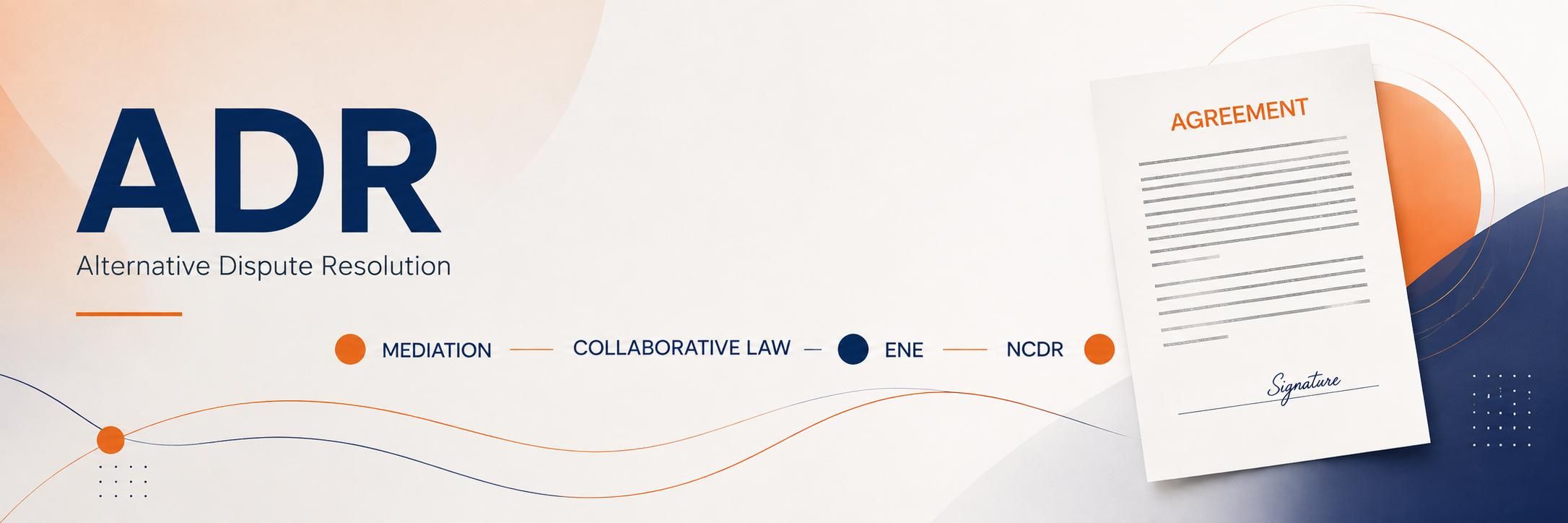
Mediation and arbitration are both forms of alternative dispute resolution, now more commonly called non-court dispute resolution, or NCDR. The family court definition also takes in collaborative law, a private FDR hearing and evaluation by a neutral third party.
This is not a soft encouragement any more. Changes to the Family Procedure Rules that took effect on 29 April 2024 mean the court can require you to file a Form FM5 setting out your position on non-court dispute resolution, can adjourn proceedings to let you try it even if you have not agreed to that, and can depart from the usual “no order as to costs” position in financial cases where a party has refused to engage without a good reason. In Re X (Financial Remedy: Non-Court Dispute Resolution) [2024] EWHC 538 (Fam), Mrs Justice Knowles made the expectation plain: the court expects a serious effort to resolve matters before proceedings are issued, and will keep assessing whether alternative dispute resolution is suitable at every stage.
Put simply, arbitration is one of the answers you can give when the court asks what you have tried. So is mediation. Doing nothing is the option that now carries a financial risk.
We see a lot of couples who assume it is mediation or court, with nothing in between. Arbitration sits neatly in that gap. The pattern that works best is mediating everything you can, then arbitrating the one issue you genuinely cannot agree on, rather than throwing the whole case at a judge because of a single sticking point.
Jess Knauf, Co-Founder, Family Law Service
When Mediation Is Not Suitable
Mediation is a good fit for most separating couples, but not all of them. The situations where it tends to fall down are reasonably predictable:
- Domestic abuse: including coercive and controlling behaviour, where a joint process would not be safe or fair
- Hidden or disputed assets: where one person will not give straight financial disclosure
- A serious power imbalance: where one person will always concede to end the discomfort
- Urgency: where a property is about to be sold or a child is at risk of being removed
- Outright refusal: mediation only works if both of you turn up
Our full guide on when mediation is not suitable goes through the exemptions in more detail. The important thing to understand is that mediation failing does not automatically mean court is your only remaining option. Arbitration may still be open to you, and it is often faster.
Arbitration vs Mediation: Which Costs More?
Mediation is the cheaper of the two, and by some distance. You are paying for a handful of sessions with one professional, and you can do it without instructing solicitors at all if you take independent advice at the right moments.
Arbitration costs more because you are paying the arbitrator’s fee, the cost of the venue or platform, and usually your own legal team to prepare and present your case. Set against a contested court case though, it still tends to come out well ahead, because you are buying a fixed date rather than an open-ended timetable with adjournments in it. Every extra hearing in the family court means another round of preparation, another set of fees, and often another few months.
Whichever way you go, protecting the money you have while the process runs matters just as much as the outcome itself. Our guide on how to protect savings during a divorce covers the practical steps, including joint account risks and what to do if you are worried about assets being moved.
Not Sure Which Route Fits Your Case?
An hour of fixed-fee legal advice with a family law specialist can tell you whether mediation, arbitration or a court application makes the most sense for your circumstances, before you spend money on the wrong one.
Arbitration vs Mediation: How to Choose
Step 1: Ask whether you can still have a conversation
Not a comfortable one. A workable one, with someone impartial in the room keeping it on track. If the answer is yes, start with mediation. You will keep control and you will spend less.
Step 2: Identify what you are actually stuck on
Couples rarely disagree about everything. More often it is one point: whether the house is sold now or when the youngest finishes school, how a pension is treated, or how school holidays are divided. Arbitration works best on a defined question like that.
Step 3: Decide how much certainty you need, and how soon
If you need a decision by a particular date, arbitration gives you one. Mediation can be quick, but it can also stall if one of you loses momentum. Arbitration has a fixed end point built in.
Step 4: Check whether children matters are involved
Arbitration is available for children disputes as well as finances, but the scope is narrower and safeguarding issues will take a case out of it. If your case is about child arrangements, take advice on which forum is appropriate before signing anything.
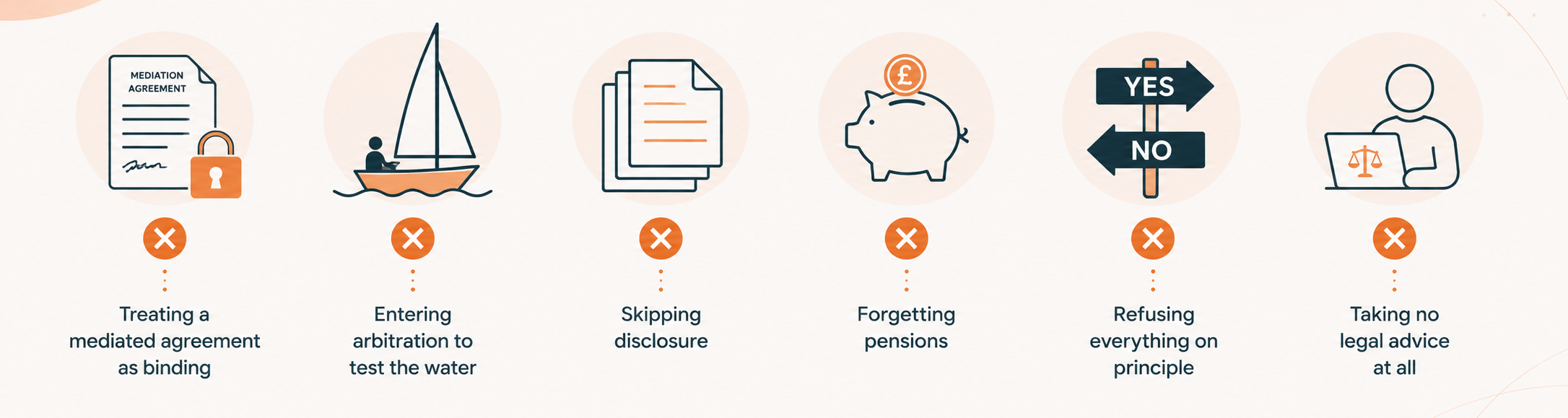
Mistakes People Make When Choosing
- Treating a mediated agreement as binding: it is not, until the court approves it
- Entering arbitration to test the water: you cannot change your mind once the award lands
- Skipping disclosure: neither process produces a fair outcome on incomplete figures
- Forgetting pensions: often the second largest asset, and easily overlooked
- Refusing everything on principle: that is now a costs risk in financial remedy cases
- Taking no legal advice at all: an impartial mediator cannot tell you if a deal is fair to you
We have written a longer piece on the most common mistakes in financial divorce settlements, which is worth reading before you finalise anything.
Making the Outcome Legally Binding
This is the step people miss. A mediated financial agreement is not enforceable on its own, and an arbitral award still needs the court’s stamp before it becomes an order. In both cases the answer is the same: a consent order, drafted properly and submitted to the family court for approval. Our clean break consent order guide explains what that document does and why it also closes off future claims.
The court fee for a financial order by consent is £62, as of July 2026 (Ministry of Justice). Our fixed-fee drafting service is £499, so a couple who have reached agreement can usually complete the whole legal step for well under a thousand pounds. That is the part that surprises people most, and it is a long way from what a contested application costs.
Summary
Mediation keeps the decisions with you. Arbitration hands them to a professional who will decide for you, quickly and bindingly. Neither is better in the abstract, and the right answer depends on whether you and your ex-partner can still work through the issues with help, and on how urgently you need certainty.
For most people, mediation first is the sensible order, with arbitration held in reserve for the one or two points that will not shift. Whichever route resolves it, the agreement needs converting into a consent order to be worth anything in law. Family Law Service can handle that final step for a fixed fee, and we have supported more than 23,000 people across our services.
Frequently Asked Questions
Is arbitration or mediation better for divorce?
Mediation is better if you and your ex-partner can still discuss the issues with impartial help, because it is cheaper and leaves the decisions with you. Arbitration is better if you have tried to agree, cannot close the gap, and need a binding decision on a defined issue without waiting for a court hearing.
Can you use mediation and arbitration together?
Yes. Many couples mediate the bulk of the settlement and then arbitrate the single point they cannot agree on. Mediators and arbitrators often refer cases to each other for exactly this reason, and it usually costs far less than taking the whole case to court.
Do you still need a MIAM if you plan to arbitrate?
If you later apply to the family court, you will usually need to have attended a MIAM first unless an exemption applies. Arbitration itself does not require one, but attending a MIAM is rarely wasted, because the mediator will tell you which route suits your situation.
Is an arbitrator’s decision legally binding?
Yes. You agree in advance to be bound by the award, and it is then converted into a court order. Following Haley v Haley [2020] EWCA Civ 1369, a party who wants to challenge an award has to show it was wrong, in the same way as on an appeal against a judge’s decision.
What happens if I refuse to try either option?
Since 29 April 2024, the family court can adjourn proceedings to allow non-court dispute resolution to be tried, and in financial remedy cases it can make a costs order against a party who refuses to engage without a good reason. Refusing on principle can end up costing you money.
You Might Also Find Helpful
Financial Settlements on Divorce Read the guide |
What Happens in Mediation – Step by Step Find out more |
Alternative Dispute Resolution Learn more |
Premium Consent Order Service View the guide |
Ready to Take the Next Step?
However you reached your agreement, through mediation, arbitration or straight negotiation, we can turn it into a legally binding clean break consent order for a fixed fee of £499, with no hourly billing and no surprises.