


Updated 3rd February 2026 | Fact Checked By Jess Knauf, Co-Founder, Family Law Service
Quick Summary: Can I Get a Consent Order Without Mediation?
- You don’t need mediation to get a consent order – it’s not a legal requirement in England and Wales
- Mediation can help if you’re struggling to agree on finances or child arrangements, but it’s optional
- You can apply directly to court for a consent order if you’ve already agreed terms with your ex-partner
- DIY consent orders are risky – courts often reject poorly drafted applications, costing you time and money
- Family Law Service helps with consent order drafting so your application gets approved first time
- Common mistakes include missing financial disclosure or using unclear wording that courts won’t approve
Can I get a consent order without mediation? Yes, absolutely. There’s no legal requirement to attend mediation before applying for a consent order in England and Wales. If you and your ex-partner have already agreed how to divide your finances or arrange child contact, you can apply directly to court for a consent order to make those arrangements legally binding.
But here’s where it gets tricky. Whilst you don’t need mediation, many people struggle to draft consent orders properly. Courts reject thousands of applications every year because they’re incomplete, unclear, or missing vital financial information. That’s where legal support makes all the difference.
In this guide, we will walk you through when you need mediation (and when you don’t), how to apply for a consent order yourself, and the common pitfalls that trip people up. We’ll also cover when it makes sense to get professional help so your application sails through court approval.
What Is a Consent Order?
A consent order is a legally binding document that records your financial agreement following divorce or separation. It’s approved by a judge and becomes an official court order.
Think of it like this: you and your ex have agreed who gets the house, how to split pensions, and whether anyone pays spousal maintenance. Without a consent order, that agreement is just a handshake. If someone changes their mind in five years, you’ve got no legal protection.
A consent order covers:
- Property and housing – who keeps the family home, or how you’ll split the proceeds if you sell
- Pensions – how to divide pension pots fairly (this is often worth more than people realise)
- Savings and investments – bank accounts, ISAs, shares, premium bonds
- Spousal maintenance – ongoing financial support, or a clean break clause
- Child maintenance – though this is usually handled separately through the CMS
Once the court approves your consent order, it’s legally binding. No one can make future financial claims against you (unless you’ve agreed otherwise in the order itself).
“We see so many people who’ve shaken hands on an agreement, only to find themselves back in dispute years later,” says Jess Knauf, co-founder of FLS. “A consent order gives you peace of mind. It’s done, it’s legal, and you can move on.”
Do I Legally Need Mediation Before Applying for a Consent Order?
No. You don’t need mediation to apply for a consent order.
This is one of the most common misconceptions we hear at Family Law Service. People assume they must attend a Mediation Information and Assessment Meeting (MIAM) before filing any court application. That’s true for some applications, like child arrangements or financial remedy proceedings where you’re asking the court to decide for you.
But if you’ve already agreed your financial split, you can skip mediation altogether and apply directly for a consent order.
Here’s the key difference:
- Contested financial applications (where you disagree) – you’ll need to attend a MIAM first and try mediation before going to court
- Consent orders (where you agree) – no MIAM required, because you’re not asking the court to resolve a dispute
You’re simply asking a judge to approve the agreement you’ve already reached.
That said, mediation can still be helpful even if it’s not legally required. Let’s look at when it makes sense.

When Mediation Might Help (Even If You Don’t Need It)
Just because you can skip mediation doesn’t mean you should. If you’re struggling to agree on finances, or if conversations keep breaking down, mediation can get you unstuck.
I remember a couple we worked with at Mediate UK” – recalls Jess – ‘Who’d been emailing back and forth for months about their house. Every time they thought they’d agreed, someone would bring up a new issue. Three mediation sessions later, they had a clear plan, and we helped them draft the consent order at Family Law Service. Job done.”
Here’s when mediation is worth considering:
- You’re mostly agreed, but stuck on one issue – like whether to sell the house now or wait until the kids finish school
- Emotions are running high – a neutral mediator can keep discussions calm and focused
- You want to avoid solicitors’ letters going back and forth – mediation is usually quicker and cheaper than formal negotiations
- You need help understanding the financial options – mediators can explain pension sharing, clean breaks, and tax implications
If you do decide to try mediation, services like Mediate UK offer fixed-fee sessions. You’ll usually need 1–3 sessions to reach an agreement, then you can move straight to applying for a consent order.
Want to get started? Just enter your name and we’ll guide you through the next steps.
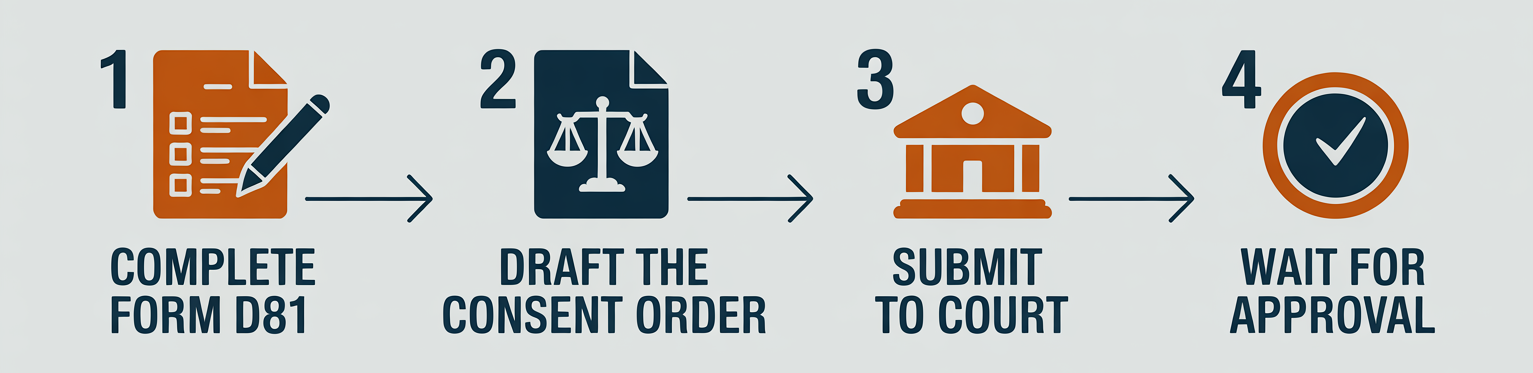
How to Apply for a Consent Order Without Mediation
If you’ve agreed terms with your ex-partner, here’s how to apply for a consent order yourself:
Step 1: Complete Form D81
Form D81 is the Statement of Information for a Consent Order. You’ll both need to fill this in, declaring:
- All your income (salary, benefits, pensions)
- All your assets (property, savings, investments, pensions)
- All your debts (mortgages, loans, credit cards)
- Your monthly living expenses
The court needs full financial disclosure from both of you. Miss something out, and your application gets rejected.
Step 2: Draft the Consent Order
This is where most DIY applications fall apart. The consent order must be crystal clear about who gets what, using precise legal wording. Vague phrases like “we’ll sort out the house later” won’t cut it.
Your consent order should cover:
- Property – including who pays the mortgage until sale, and how you’ll split the proceeds
- Pensions – whether you’re doing a pension sharing order or offsetting
- Spousal maintenance – even if it’s nil, you need to say so
- Clean break clause – this stops either of you making future claims
Step 3: Submit to Court
You’ll send:
- Your completed Form D81 (both of you)
- Two copies of the draft consent order
- Your decree nisi (or decree absolute if you’ve already got it)
- A cheque for £62 (the court fee)
You send it to the court that’s handling your divorce. The court will review your application and either approve it, reject it, or ask for more information.
Step 4: Wait for Approval
A district judge will review your paperwork. If everything looks fair and properly drafted, they’ll approve it. You’ll get back a sealed copy of the consent order, and that’s it – legally binding.
“We see a lot of people try to draft their own consent orders, and courts send them back for basic errors,” says Jess Knauf. “Something as simple as forgetting to include a clean break clause can mean your application gets rejected, and you’ve wasted weeks waiting.”
Common Mistakes When Applying for a Consent Order
The court rejects consent orders for all sorts of reasons. Here are the most common mistakes we see at Family Law Service:
1. Incomplete Financial Disclosure
You must declare everything. That includes:
- Pension values (not just current contributions)
- Premium bonds and NS&I accounts
- Any inheritance you’ve received or expect to receive
- Business interests or shares
Leave something out, even accidentally, and the court will reject your application. Or worse, the order could be set aside later if your ex discovers hidden assets.
2. Vague or Unclear Wording
“Sarah gets the house” isn’t enough. The order needs to specify:
- When the house will be transferred
- Who pays the mortgage in the meantime
- Whether there’s any payment from Sarah to compensate for the equity
- What happens if Sarah can’t get a mortgage in her sole name
Courts won’t approve woolly language. You need precision.
3. No Clean Break Clause
If you want a clean break (where neither of you can make future financial claims), you need to say so explicitly in the order. Without a clean break clause, either of you could come back to court years later asking for spousal maintenance or a share of inheritance.
Even if you’re not paying maintenance, you still need the clean break wording. It’s the only way to close the door on future claims.
4. Ignoring Tax Implications
Transferring property between spouses is usually tax-free, but only if you do it within certain timeframes. If you wait too long after your decree absolute, you could face capital gains tax bills.
Same goes for pensions. A pension sharing order has different tax rules than a pension offsetting arrangement. Get it wrong, and you’ll both lose money.
5. Not Including Pension Valuation
Courts expect you to include recent pension valuations in your financial disclosure. “I think it’s worth about £50,000” isn’t good enough. You need the Cash Equivalent Transfer Value (CETV) from your pension provider.
Pensions are often the second-biggest asset after the family home. Courts won’t approve an order that ignores them.
When to Get Legal Help with Your Consent Order
You can apply for a consent order without mediation or solicitors, but it’s risky. Here’s when it makes sense to get professional help:
- You own property together – especially if there’s a mortgage or you’re transferring ownership
- Either of you has a pension – pension sharing orders are complex and easy to get wrong
- You’re not sure about tax implications – capital gains tax, stamp duty, pension tax relief can all catch you out
- You want to protect against future claims – a solicitor will make sure your clean break clause is watertight
- Your finances are complicated – multiple properties, business interests, overseas assets
At Family Law Service, we provide a fixed-fee consent order drafting service designed to get your application right first time. We prepare the wording properly, in line with court requirements, reducing the risk of rejection and delays — without the cost of full legal representation.
If your finances are more complex, our Premium Consent Order service gives you full support from start to finish. This solicitor-led, fully regulated package reviews your agreement, includes a 90-minute session with an independent facilitator, and covers the drafting of all required documents. We manage the entire court submission process on your behalf, with a free re-draft guarantee, so you don’t have to manage the paperwork yourself.
Case Law: When Consent Orders Get Set Aside
Courts rarely overturn consent orders once they’re approved, but it does happen. The leading case is Edgar v Edgar [1980], which established that consent orders can only be set aside if there was fraud, mistake, or material non-disclosure.
In practice, this means:
- If you lied about your finances – like hiding a bank account or undervaluing your pension – the court can set aside the order
- If you made a genuine mistake – like miscalculating your equity in the house – you might get the order varied
- If circumstances change drastically – like a serious illness or job loss – you might be able to ask the court to reconsider
More recently, in Sharland v Sharland [2015], the Supreme Court set aside a consent order because the husband had lied about the value of his company shares. The wife ended up with a much bigger settlement when the truth came out.
The lesson? Be honest about your finances. Trying to hide assets or downplay their value will almost always backfire.
How Much Does a Consent Order Cost?
The court fee for a consent order is £62. That’s it. If you’re on a low income or benefits, you might qualify for fee remission (Help With Fees).
But there are other costs to consider:
- Pension valuation – most pension providers charge £50–£200 for a CETV statement, however you are usually entitled to one free pension statement each year, so be sure to ask.
- Property valuation – if you’re agreeing how to split the house, you’ll need a recent market valuation
- Legal advice – if you use a solicitor to draft the order, expect to pay £500–£1,500 depending on complexity
If you went through mediation first, you’d typically spend £500–£1,500 on that (depending how many sessions you need). So skipping mediation can save you money, as long as you’ve already agreed terms.
Can I Change a Consent Order Later?
Once a consent order is approved, it’s difficult to change. You’d need to apply to court to vary the order, and you’d need a good reason – like a significant change in circumstances.
For example:
- You agreed spousal maintenance and the payer loses their job – they might apply to reduce or suspend payments
- You agreed to sell the house when the youngest child turns 18, but they’re now disabled and need ongoing care – you might ask to postpone the sale
You can’t just change your mind because you think you got a bad deal. Courts expect you to stick to what you agreed, unless something genuinely unforeseen has happened.
That’s why it’s so important to get the order right first time. Don’t agree to terms you can’t live with just to get it over with.
FAQs About Consent Orders and Mediation
Do I need a consent order if we’ve agreed everything?
Yes. Even if you trust your ex-partner completely, you need a consent order to make your financial agreement legally binding. Without it, either of you could change your mind or make future claims – even years after your divorce.
Can I apply for a consent order before my Conditional Order (decree nisi)?
No. You need you conditional order before the court will consider a consent order application. Most people apply between conditional order (decree nici) and final order (decree absolute), but you can apply after final order if needed.
What if my ex won’t agree to a consent order?
If your ex refuses to agree, you can’t get a consent order. Instead, you’d need to apply for a financial remedy order, where the court decides how to divide your assets. This requires a MIAM and usually several court hearings. It’s much more expensive and stressful than agreeing a consent order.
How long does a consent order take to get approved?
Usually 4–8 weeks from the date you submit your application. It depends how busy the court is, and whether they need to ask you for more information. If your paperwork is complete and properly drafted, it should go through fairly quickly.
Can I get a consent order if we were never married?
No. Consent orders only apply to divorcing couples. If you were cohabiting (living together but not married), you don’t have the same legal protections. You’d need to sort out property and finances through other legal routes, like a declaration of trust or a TOLATA application.
What happens if we don’t disclose all our finances?
The court could reject your application, or set aside the order later if it discovers non-disclosure. In extreme cases (like Sharland v Sharland), you could end up back in court years later, paying far more than you would have in the first place. Always be honest about your finances.
Final Thoughts: Get It Right First Time
You don’t need mediation to get a consent order, but you do need to get the paperwork right. Courts reject poorly drafted applications every day, costing people time, money, and stress.
If you’re confident drafting legal documents, go ahead and apply yourself. But if you’ve got property, pensions, or complicated finances, it’s worth getting professional eyes on your draft before you submit it.
At Family Law Service, we offer:
- Clean-break consent order drafting – suitable only where there is one property and no business interests, pension sharing or spousal maintenance.
- Premium consent order service – with solicitor-led drafting and full court submission support from start to finish
- Court prep meetings – we’ll walk you through what to expect if your application is queried
- One-hour legal advice sessions – get clarity on whether your agreement is fair before you commit to it
We’ve helped hundreds of people get their consent orders approved first time, without the stress of DIY guesswork.
Ready to Take the Next Step?
Filing for divorce is just the beginning. What you’re entitled to financially can make a huge difference to your future security and peace of mind.